Asian American Journalists Association at Carolina: Securing our Tar Heel Legacy
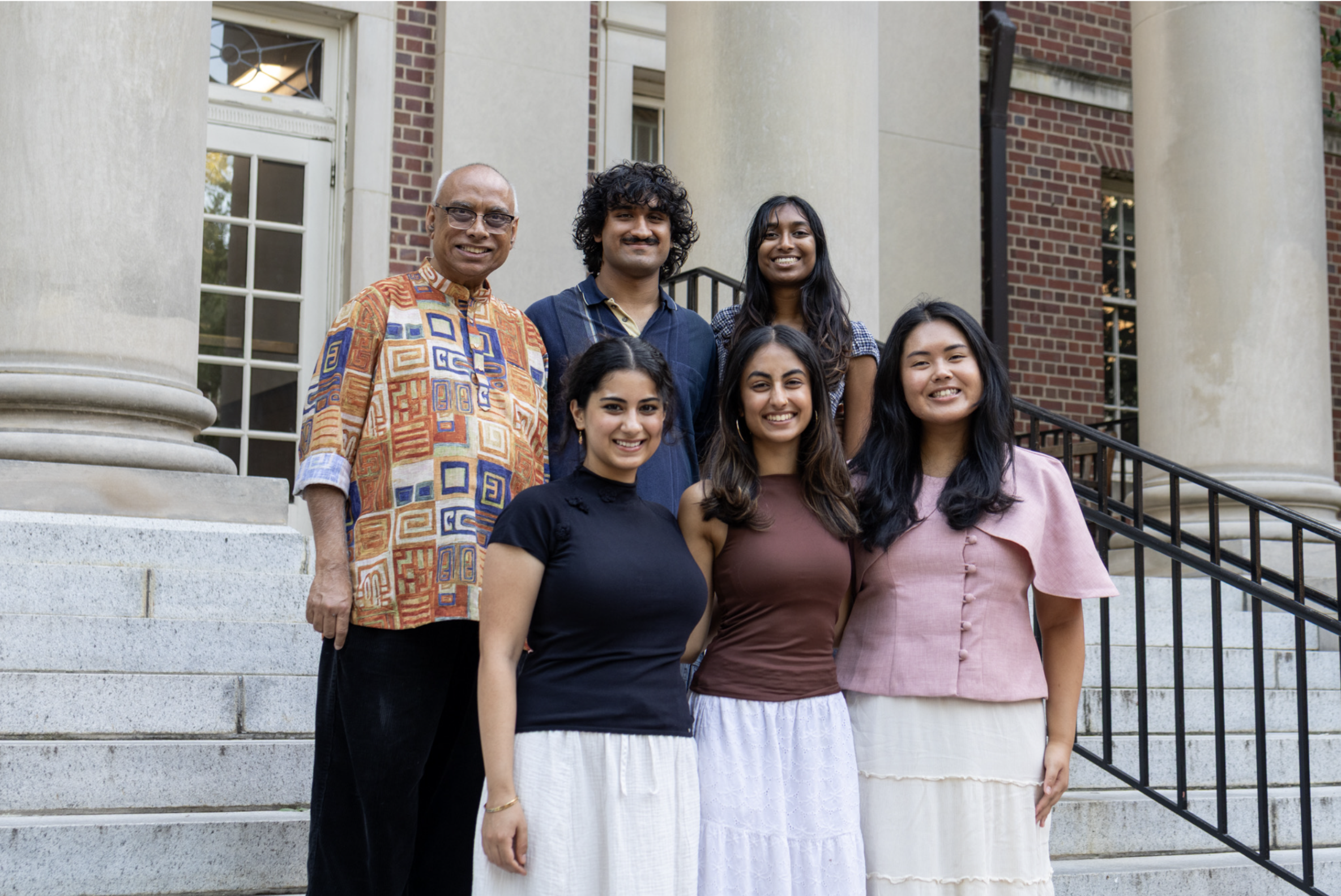
AAJA Carolina executive team poses for a picture outside Carroll Hall. Photo Credit: Ava Sharon
Viyada Soukthavone always knew she wanted to be a journalist. A first-generation student with assured admission to the Hussman School of Journalism and Media at UNC Chapel Hill, she arrived in the fall of 2023 bright-eyed and bushy-tailed.
In her first couple of weeks on campus, Soukthavone met with a Hussman advisor, seeking to find a space where she could improve her skills as a journalist and feel represented as a Lao American. She knew that journalism affinity groups existed and saw that UNC had chapters for the National Association of Hispanic Journalists and the National Association of Black Journalists.
However, she had not heard about any campus organizations for Asian journalists, although she was aware that there was a national one. Soukthavone asked the advisor if there was an Asian American Journalists Association at UNC.
The advisor said no.
Undeterred, she asked if it would be possible for her to start one.
Once again, they said no.
She left the meeting with her tail tucked between her legs.
“I was very much a leader growing up,” Soukthavone said. “Obviously, college is a different experience, but I felt like, ‘Oh, I can do that.’ And in that moment, I just felt very belittled.”
She recalled her advisor saying that an affinity group for international students would be coming to UNC soon and that she was welcome to join it. She found the implication that her identity as an Asian American was equivalent to being an international student to be strange.
“It felt like she was putting me in a box in a way, and I didn’t really appreciate that,” Soukthavone said.
When she didn’t find the support she was expecting, Soukthavone threw herself into other things. She joined The Daily Tar Heel as a photographer, working her way up to become an editor by just her sophomore year.
While she was with the DTH, she served as a member of the DEI Committee as well as a co-leader for the Sharif Durhams Leadership Program, which is an affinity group within the newsroom specifically intended to empower journalists who come from minority backgrounds.
Soukthavone never stopped working toward enhancing spaces where journalists of color could thrive, but she didn’t revisit the idea of AAJA until the end of her junior year.
She recalled speaking to Elaine Jimenez, the president of UNC’s NAHJ chapter at the time, about her experience with being shut down and not having an organization that she could truly belong to. She said that Jimenez went to the advisor for NAHJ, Professor Paul Cuadros, and told him about Soukthavone’s frustrations.
Meanwhile, Cuadros had noticed a large gap in Pan-Asian representation in journalism over the past several years.
“I’ve been at Hussman almost 20 years, and we’ve always had a smaller Pan-Asian student population,” Cuadros said.
Cuadros said that he was noticing the same trend with Asian journalism students that he had previously seen with Latinx students, which was the reason he decided to establish an NAHJ chapter at Hussman.
He hoped to serve as a catalyst for an AAJA chapter at UNC by bringing together a group of passionate students and letting them take it from there.
Cuadros said that students were capable of doing all kinds of incredible things if someone just had faith in their ideas and let them pursue those endeavors.
One such student was Keya Mahajan, a junior at Hussman who is also the DEI coordinator for The Daily Tar Heel.
“[Cuadros] pulled me aside on maybe the second day of class [in spring 2026],” Mahajan recalled. “He asked me about my experience and if I noticed a need for AAJA or something adjacent at Carolina. I was happy to say yes.”
Soukthavone shied away from starting a chapter due to a lack of support. With Mahajan on board, there was a hope for change.
In late May 2026, Jimenez created an email chain formally introducing Cuadros to Soukthavone. He added Mahajan to the chain, citing her interest in starting the chapter and suggesting that the three of them find a time to meet over the summer to get started on the process of bringing AAJA to UNC.
On May 29, 2026, two students and a professor across three different states found the time to hop on a morning Zoom call to begin discussing the logistics of starting a club designed to support Asian American journalists at UNC.
This meeting served as an introduction. Soukthavone and Mahajan met in an official capacity and shared with Cuadros why they wanted to bring AAJA to campus. Despite having only met virtually since Soukthavone and Mahajan were interning in D.C. and Charlotte respectively, the girls hit it off instantly.
“Starting a club at a school is difficult,” Mahajan remarked. “You really need someone to help you out and a partner with you to do it, and Viyada is the perfect person. I cannot emphasize enough how hardworking, kind and passionate she is… not only as a leader, but also as a friend.”
The two decided that they would be co-presidents of the organization. Soukthavone is graduating in December 2026, so this would make it easy to hand the reins over.
In the meeting, Cuadros provided insight into his experience with starting NAHJ and suggested some first steps they could take. One of those was finding an advisor, which he warned them to be strategic about.
He explained they should choose a professor who has tenure with the university, as it would make the organization's prospects look better in the long run, particularly due to all the controversy surrounding DEI initiatives.
Soukthavone and Mahajan ended up choosing Deb Aikat, an award-winning scholar who has received numerous accolades during his 31 years at UNC. He also had experience with organizations like AAJA, having founded the South Asian Communications Association in 2016 as well as collaborating with the national chapter of AAJA on several occasions. This made him the perfect fit for the role.
When Mahajan and Soukthavone approached him with this request, he was happy to accept. He too had noticed a gap in representation for a Pan-Asian student organization at Hussman and was eager to change that.
"There are so many things that happen around the world that divide [Asian communities],” Aikat said. “This is an effort to unite us.”
Asia is the most diverse continent in the world, so much so that the word “Asian” is far too broad to encapsulate the unique nature of the numerous cultures that call the region home.
Junior Nikhil Mehta, the treasurer for UNC’s chapter of AAJA, said that this vagueness works for this particular organization. “We want it to be broad,” Mehta said.
He recalled when the executive team was putting together a presentation for S.O.L.E Fest, one of UNC’s biggest student organization tabling events of the year, and they were trying to figure out how to decorate the board.
“I went and I found flags for basically every country in Asia because we wanted to show that we’re going to be inclusive of all of Asia, not just East Asia or South Asia,” Mehta said.
Cuadros also suggested reaching out to both the national chapter of AAJA and student groups at other universities to see if they had any ideas to offer.
Soukthavone said they were able to get recognition for AAJA Carolina from the national chapter and contacted chapters at UT Austin and Syracuse to inquire about how they could get their students engaged and make the organization as fulfilling as possible.
One challenge they faced was the fact that while AAJA is a professional student organization, it is also a cultural one. This issue arose when the executive team was planning the interest meeting. Soukthavone said they wanted to make the space as welcoming as they could.
“We want this to be a safe space for all identities,” Soukthavone said. “We want people to just feel as comfortable as possible.”
But what did that entail? The team knew they had to have some sort of presentation to introduce the organization but were concerned about it becoming too formal. They settled on bringing in traditional foods and setting up the tables in a way that was conducive to conversation.
The interest meeting took place on September 17. Mahajan provided homemade chai, samosas, and galub jamun. Students of all Asian identities gathered around tables, getting to know each other and gushing over how good the snacks were.
Soukthavone looked on from where she was standing in the front of the room with an expression of pure joy on her face. The meeting was everything that her first-year self wished she had.
After the meeting came to an end, a student approached her and said the environment AAJA hoped to foster was just what she had been looking for during her time at Carolina. She had struggled to connect with the communities that she felt she should be part of and had since chosen to focus on other things, but she had big hopes about AAJA.
Soukthavone hugged her and said that she was so happy she had given their organization a chance. She told the student that she was sure AAJA would be exactly what she needed — just like it was for her.